

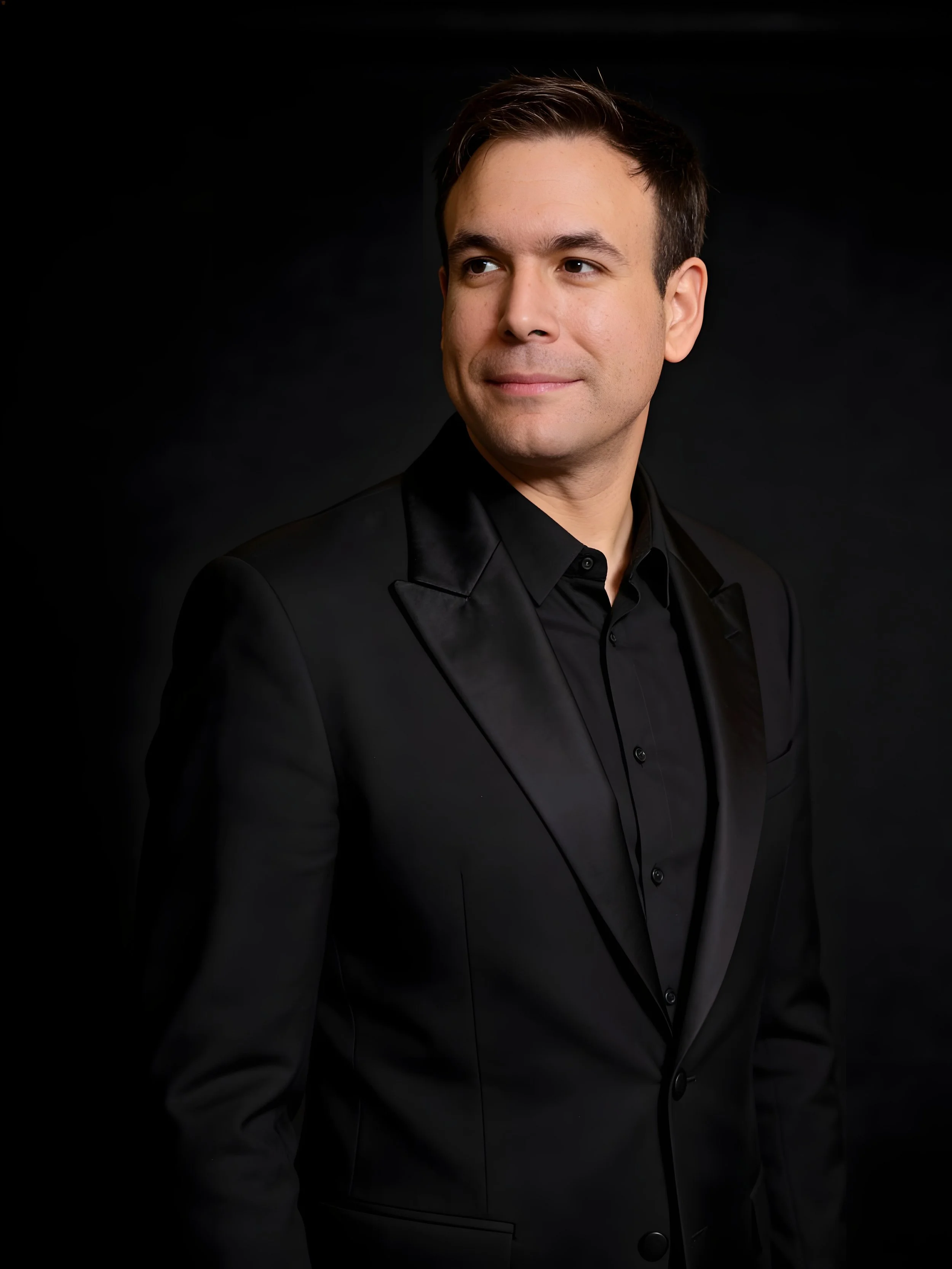
ABOUT KRISTO KONDAKÇi
Albanian-American conductor Kristo Kondakçi is the David & Janet McCue Music Director of the Kendall Square Orchestra (K²O). His performances have drawn praise for their nuance, pacing, and dramatic immediacy, with the Boston Musical Intelligencer writing that “each subtle gesture of Kondakçi’s baton seemed to suspend time” and describing the audience as “transfixed.”
During the 2026–27 season, Kondakçi makes his debut with the Portland Symphony Orchestra in its Discovery Concert series, following his work with the orchestra as a cover conductor.
In March 2026, he led Mahler’s Sixth Symphony “Tragic” with K²O in a performance hailed as “inspired and inspiring” by the Boston Musical Intelligencer. The review praised his thoughtful phrasing, attention to Mahler’s detailed markings, and ability to give each movement shape, concluding that the performance was “not so much tragic as cathartic.”
Kondakçi’s engagement with Mahler runs deep. As a student at New England Conservatory, he reconstructed a performing edition of the original 1889 version of Mahler’s First Symphony, premiered by the NEC Philharmonia under Hugh Wolff and covered by The Boston Globe, GBH, and the Boston Musical Intelligencer, among others.
His earlier appointments include Conducting Fellow with the Boston Philharmonic Orchestra and Assistant Conductor of the Boston Landmarks Orchestra. In 2020, he made his U.S. opera conducting debut with Enigma Chamber Opera in a sold-out production of Britten’s The Turn of the Screw. The Boston Globe wrote that Kondakçi “commanded a keen chamber orchestra and deftly balanced its dynamics with the singers.”
As Music Director of the Kendall Square Orchestra, Kondakçi leads a uniquely interdisciplinary ensemble of nearly one hundred musicians drawn from more than seventy institutions across science, medicine, technology, education, and the arts. Under his leadership, K²O has become known for ambitious programming, major philanthropic partnerships, and performances that bring the symphonic tradition into conversation with contemporary civic life.
Central to Kondakçi’s work is the relationship between music and audience. His concerts frequently combine thematic programming with spoken introductions from the stage, offering a personal and accessible way into the repertoire while drawing connections between the works themselves and the larger human questions they carry.
Kondakçi believes an orchestra should be a force in the life of its community. Through K²O’s biennial Symphony for Science initiative at Boston’s Symphony Hall, he brings together leaders in science, medicine, philanthropy, and the arts while raising significant support for local nonprofits. Most recently, the initiative benefited Boston Health Care for the Homeless Program in partnership with the Harvard T.H. Chan School of Public Health.
Born in Tirana, Albania, Kondakçi came to the United States with his family as a political refugee following decades of persecution under the Communist regime. His grandfather, Beqir Omari, was imprisoned for performing Western music; his great-uncle, a physician and virtuoso musician, was executed; and members of his family were sent to internment camps. That history continues to shape Kondakçi’s belief in the transformative power of music and his gratitude for the freedom to devote his life to an art for which members of his own family once paid a profound price.
Following his debut with the Albanian National Orchestra in 2014, Kondakçi was recognized as a cultural representative of the Albanian diaspora and maintains an ongoing relationship with the National Theatre of Opera and Ballet of Albania.
In 2017, Kondakçi co-founded the Eureka Ensemble, a professional orchestra that gained national attention for expanding the role orchestral music could play in contemporary civic life. The following year, its Sheltering Voices initiative brought professional musicians together with women experiencing homelessness in a project centered on recovery from abuse. A NowThis feature on the project was viewed more than three million times, and the work helped give rise to the Women’s Chorus, which Kondakçi co-founded with David McCue in partnership with the Women’s Lunch Place and which has since served more than 150 women. He was later profiled by the Christian Science Monitor in its “People Making a Difference” series, which described him as “a dynamic force” behind efforts using music as an agent of social change.
During the first months of the COVID-19 pandemic, Kondakçi helped lead the launch of Boston Hope Music at Boston’s 1,000-bed field hospital, working alongside physicians and musicians to bring together more than 100 Boston-area artists for patients recovering from COVID-19. The initiative later expanded in a partnership with New England Conservatory and Massachusetts General Hospital to support frontline healthcare workers through private music lessons and songwriting programs, and ultimately brought live music to mass-vaccination sites across Boston. The project was featured by GBH and later received First Honorable Mention in the National Organization for Arts in Health’s “Arts Building Resilience” awards.
Kondakçi serves as Assistant Professor of Conducting at Berklee College of Music and as Non-Resident Tutor in Music at Harvard University. He is a frequent speaker on music, leadership, and community engagement and has appeared at TEDxBoston and the League of American Orchestras.
He holds Master of Music and Bachelor of Music degrees from the New England Conservatory, where he serves on the President’s Council. He lives in Boston with his wife, Chloe.
LAST UPDATED AUGUST 2026. PLEASE DESTROY ALL PREVIOUSLY DATED MATERIALS. EDITS MUST BE APPROVED BEFORE USE.